
How to Build Passive Income Through Multilevel Marketing (Realistically)
 tobs ·
·
13 min read
tobs ·
·
13 min read

In this article, you will learn exactly how learn about the no fluff, way to to build a passive income through multilevel marketing. No hypes, No gimmicks, just real stuff! If you want real results, then this is for you!
Let’s be honest with each other from the start.
It’s more than likely you have heard someone say it before — a friend, a cousin, maybe someone in your church or office. They sat you down, opened their laptop, and showed you a compensation plan full of circles and arrows. They said things like “residual income,” “be your own boss,” “work from anywhere.” They made it sound like you could join today and be comfortable by next year.
Something Like This…
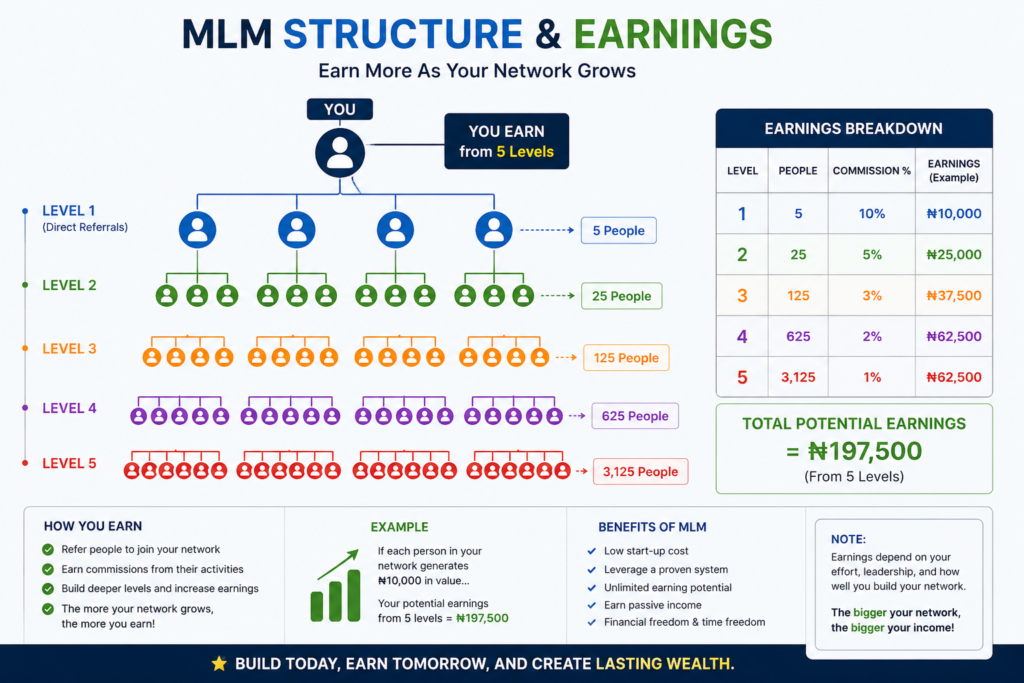
Maybe you joined. Maybe you didn’t. Maybe you lost money. Maybe you are still deciding.
This article is not here to sell you anything. It is here to tell you the truth — the full truth — about what passive income through multilevel marketing actually looks like, what it takes to achieve it, and how to protect yourself from the version of MLM that ruins people financially and socially.
By the time you finish reading, you will know exactly what steps to take, what to avoid, and whether MLM is even the right vehicle for your goals.
First, Let’s Understand What “Passive Income” Actually Means
Passive income means money that comes in regularly without you having to actively work for it every time. A landlord collecting rent. An author earning royalties. A content creator earning ad revenue from videos uploaded two years ago.
The keyword is eventually. Passive income is almost never passive at the beginning. It always requires a period of active, consistent work before the income starts flowing on its own. Anyone who tells you otherwise is either lying or selling you something.
In the context of MLM, passive income is supposed to come from your downline — the people you recruit, the people they recruit, and so on. When those people buy products or sell products, you earn a percentage. That is the theory.
The reality, as we will explain, is more complicated.
What MLM Actually Is (Plain English Version)
MLM, which stands for Multilevel Marketing, is a business model where:
- A company sells products (supplements, cosmetics, household items, insurance, etc.)
- Instead of using a traditional distribution chain, they recruit ordinary people to sell directly
- Those sellers are rewarded not just for selling products, but for recruiting other sellers
- When your recruits sell, you earn a cut. When their recruits sell, you earn a smaller cut. And so on.
This is the “multilevel” part — your earnings can come from multiple levels below you.
On paper, it sounds clever. In practice, most people make very little or nothing. We will show you why shortly — and more importantly, how to be in the minority that actually succeeds.
The Hard Numbers You Need to See
Before you invest a single naira, you need to understand the statistics.
The United States Federal Trade Commission (FTC) reviewed income disclosure statements from major MLM companies and found that across most companies, more than 73% of distributors earn less than ₦50,000 per year — with many earning zero or going into debt.
Now, Nigeria is different from America. Our cost of living is lower in some areas, our hustle culture is strong, and our social networks are deep. That gives Nigerians some natural advantages in MLM.
But the underlying math of the model does not change based on geography. The model still requires you to build a large, active team that sells real products consistently. That is genuinely hard work, and most people quit before they reach that point.
Here is the uncomfortable question you must ask yourself: “Of the people I would recruit, how many would genuinely commit to this for at least two years?”
If the honest answer is “not many,” then your passive income dreams are resting on an unstable foundation.
The Two Types of MLM: Know Which One You Are Joining
Not all MLMs are the same. There is a critical difference between a product-focused MLM and a recruitment-focused MLM (which is essentially a pyramid scheme wearing a business suit).
Product-Focused MLM
- Most of the company’s revenue comes from actual retail sales to customers who are not distributors
- Products are genuinely useful and reasonably priced
- You can make decent income just by selling — recruitment is a bonus, not a requirement
- The compensation plan rewards sales volume, not just recruiting
Recruitment-Focused MLM (Danger Zone)
- Most revenue comes from distributors buying starter kits and products to “qualify”
- Products are overpriced and hard to sell to outsiders
- The emphasis in every meeting is on who have you brought in?
- People at the bottom pay for the income of people at the top
In Nigeria specifically, many companies that operate as MLMs are actually recruitment schemes. Some have already been banned by the Securities and Exchange Commission (SEC) of Nigeria. Before you join anything, check the SEC Nigeria website or call their office. This one step can save you everything.
How Passive Income in MLM Actually Gets Built
If you have found a legitimate, product-focused MLM and you are serious about building real passive income, here is what the journey looks like honestly.
Stage 1: The Foundation Years (Month 1 to 18)
This stage is not passive at all. It is some of the most active work you will do. During this time, you are:
- Learning the products deeply so you can sell with confidence, not just scripts
- Building a small customer base of people who genuinely buy and repurchase
- Recruiting a handful of serious people (not everyone — serious ones)
- Training your recruits so they can actually produce results, not just sign up
Most people skip this stage. They focus on recruiting fast, sign up people who are not serious, and then wonder why their “team” produces no income.
Building a real downline is like building a staff — you have to train them, support them, and sometimes let go of those who are not committed.
If you rush through Stage 1, Stage 2 never comes.
Stage 2: The Growth Phase (Month 18 to 36)
By now, if you have done Stage 1 correctly:
- You have 5 to 15 active team members who are consistently buying and selling
- Some of them are starting to build their own teams
- Your monthly earnings are starting to reflect team performance, not just your personal effort
- You are doing less selling and more coaching
This is where the early signs of passive income appear. Your phone shows commission alerts from sales made by people you trained. It feels good. It is real.
But it is also fragile. People quit. People get discouraged. People move on to other things. Your job at this stage is to keep building momentum so the losses are replaced by new growth.
Stage 3: Residual Income (Year 3 and Beyond)
If your team is large enough, active enough, and the company is stable enough, you start experiencing what MLM promises — income that continues even when you reduce your personal activity.
The key word is reduce, not stop. Even top earners in legitimate MLMs maintain some level of engagement because without it, teams eventually dissolve.
True passive income from multilevel marketing is possible. It is just not a 90-day achievement. It is a multi-year one.
The Nigerian Context: Advantages and Pitfalls
Nigerians have real strengths that can work well in multilevel marketing:
Our natural advantages:
- We are naturally social and community-oriented — strong networks make recruitment easier
- We have a culture of hustle and resilience that sustains long-term effort
- We are good at storytelling and persuasion, which helps with both selling and recruiting
- Trust within family and community networks can create loyal customer bases
Our specific risks:
- Many Nigerians confuse MLM with get-rich-quick schemes, and legitimate companies suffer by association
- The pressure to “show success” can lead to spending money on appearances (luxury meetups, fake screenshots) instead of building real business
- Family and friendship loyalty can make it hard to be honest when recruiting — leading to resentment later
- Electricity, data costs, and transportation can silently eat into already thin margins
Practical advice for the Nigerian context:
Do not use church groups, family gatherings, or close friendships as your primary recruitment ground. Recruit strangers and acquaintances first. Build proof of results before you bring family in. This protects your most important relationships.
A Step-by-Step Action Plan
If you have decided you want to try this legitimately, here is what to do:
Step 1: Research before you sign anything. Go to the SEC Nigeria website and confirm the company is registered. Search the company name with words like “complaint,” “scam,” and “review.” Read income disclosure statements if available. Ask to speak to two current distributors at different levels — not the person recruiting you.
Step 2: Evaluate the product honestly. Would you buy this product even if there were no business opportunity attached? If the answer is no, walk away. Products that only sell because of the income promise have no sustainable market.
Step 3: Calculate your real startup cost. Add up everything: registration fee, starter kit, monthly autoship requirement, transportation to meetings, data for training calls, promotional materials. This is your monthly cost. Write it down. Make sure your initial sales can cover this cost within 90 days, otherwise you are paying to work.
Step 4: Set a 12-month realistic income target. Not the top earner’s income. A realistic one. If your sponsor earned ₦80,000 in their first year, plan for something in that range. Then calculate how many customers and how many active team members you need to hit that number.
Step 5: Build customers before you build a team. This is the most counterintuitive but most important advice. Most people recruit first and sell second. The problem is that when you build a team before you have customers, everyone on your team is also trying to recruit instead of sell. Nobody is making retail profit, and the whole thing collapses.
Get at least 10 paying, repeat customers before you recruit a single person. Then, when you recruit, you can show them a real customer list and real retail profit — not just a compensation plan.
Step 6: Recruit for quality, not quantity. Five serious people will beat fifty uncommitted ones every time. Look for people who already have some discipline in their lives — a job, a side business, a consistent skill. People who already have nothing going on rarely do well in MLM either.
Step 7: Teach your team to sell, not just recruit. Your team’s income — and therefore your passive income — depends on retail sales. Train them in basic sales skills: how to talk about the product without pressure, how to handle objections, how to follow up. Most MLM companies provide scripts but not real sales skills. Fill that gap.
Step 8: Track your numbers every month. Create a simple spreadsheet. Track: personal sales, team sales, total commissions, total expenses, profit or loss. Many people stay in a losing MLM for too long because they never actually track the numbers. The moment you start losing money consistently with no growth trend, make a decision quickly.
Signs You Should Walk Away
Sometimes the right decision is to exit. Walk away if:
- You have been active for 12 months with consistent effort and you are still losing more than you earn
- The company asks you to buy more products to “maintain rank” with no real customer demand
- Your upline discourages you from tracking your losses (“just keep going, it’s a mindset thing”)
- You are borrowing money or using emergency savings to fund your “business”
- You feel ashamed to tell people you love that you joined
Quitting is not failure. Quitting a bad investment before it takes everything from you is wisdom.
Alternatives Worth Considering
If passive income is your goal but MLM feels too risky, consider these alternatives that are more suitable for the Nigerian market:
- Digital products: Create and sell an ebook, course, or template on a topic you know well. Once created, it earns repeatedly.
- Real estate: Even without owning property, you can earn commissions as a property agent, which builds toward ownership.
- Agriculture investments: Platforms like ThriveAgric and others allow you to invest in farming with returns.
- Content creation: YouTube, TikTok, and blog content can generate ad income once an audience is built.
- Agency business: Learn a marketable skill (social media management, copywriting, graphic design) and build a client base that grows into a team.
These models are not faster than MLM. But they are more predictable and do not require you to recruit people you care about.
The Bottom Line
Passive income through multilevel marketing is real, but it is earned slowly. It is built through years of genuine sales, careful recruiting, consistent training, and the kind of patience that most people abandon when the money does not come fast enough.
If you go in with realistic expectations, a legitimate company, a product people actually want, and a plan that focuses on customers first — you give yourself a real chance.
If you go in chasing the fast money dream, recruiting everyone you know, avoiding the math, and spending money you do not have — you will become a statistic in someone else’s income disclosure statement.
The truth is that multi level marketing in Nigeria is evolving rapidly.
People are becoming more skeptical of platforms that focus only on recruitment without offering real value. The new generation of entrepreneurs wants something more sustainable — products people can actually use, systems that encourage growth, and compensation structures that reward consistency instead of hype.
That is part of why companies like Mudet Real Solutions are starting to stand out in conversations around the future of network marketing in Nigeria.
Rather than positioning itself as just another MLM company, Mudet Real Solutions is building around a combination of health, wellness, business empowerment, and digital opportunities.
The focus is gradually shifting toward helping members build real customer networks while also creating multiple income channels through product sales, team building, and leadership development.
One of the things many people find attractive is the compensation structure. Instead of relying on only one way to earn, the system is designed around different earning opportunities such as direct referral bonuses, team growth commissions, leadership rewards, and performance incentives.
This creates the possibility for members to earn not just from personal efforts, but also from helping others grow within the system.
The product side is equally important because long-term MLM success usually depends on whether people genuinely want the products outside of the business opportunity itself.
That is why modern network marketing companies are beginning to pay more attention to practical everyday solutions instead of just selling dreams.
Of course, like every business model, success is never automatic. It still requires patience, consistency, learning, relationship building, and the ability to provide value to people.
But the industry itself is clearly changing, and newer platforms are trying to position themselves differently from the traditional MLM systems many Nigerians became skeptical about years ago.
For those looking to explore newer opportunities in the industry, Mudet Real Solutions represents one of the emerging faces of modern multilevel marketing in Nigeria.
👉 Click here to learn more about Mudet Real Solutions and how the system works.
Have questions about evaluating a specific MLM company or compensation plan? Drop them in the comments and we will break it down together.
Share this article with someone who is being recruited into an MLM right now. It might be the most useful thing you do for them this week.

Written by tobs
Not a licensed financial advisor. Always verify before you invest.
Leave a Reply