
3 Basic Concepts in Forex Trading Every Beginner Should Know
 tobs ·
·
12 min read
tobs ·
·
12 min read

Forex trading can seem confusing when you are just starting. You may come across unfamiliar terms such as pips, spreads, take-profit orders, and stop-loss orders. Understanding these terms is important because they explain how currency prices move, how trading costs work, and how traders manage potential profits and losses.
Before placing a forex trade, every beginner should understand the basic concepts in forex trading. You do not need to know everything at once, but you should have a clear understanding of how prices are measured and how orders are used to manage an open position.
In this guide, we will explain three important concepts in simple language:
-
Pips and spreads.
-
Take-profit orders.
-
Stop-loss orders.
These concepts are not a guarantee of success. Forex trading involves risk, and prices can move quickly. However, learning these fundamentals can help you make more informed and disciplined trading decisions.
1. Pips and Spread
Pips and spreads are two of the first terms beginners encounter in forex trading. A pip measures how much the price of a currency pair has changed, while the spread represents the difference between the buying and selling prices.
Understanding both concepts helps you read price movements and estimate the cost of entering a trade.
What is a pip in forex?
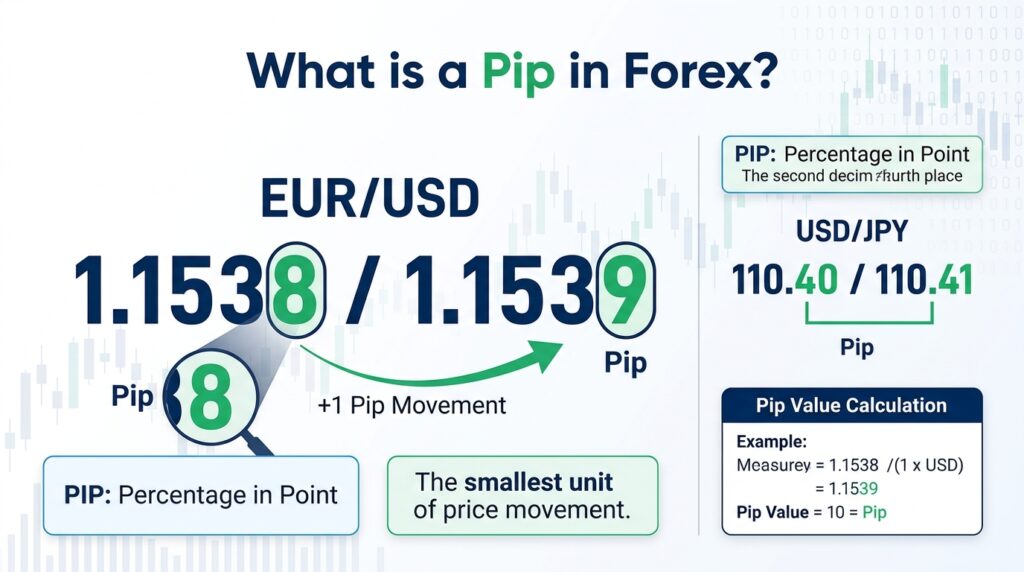
A pip is a standard unit used to measure price movement in the forex market. The word “pip” is commonly understood as “percentage in point” or “price interest point.”
For most currency pairs, one pip is equal to the fourth decimal place. For example, if EUR/USD moves from 1.2000 to 1.2001, the pair has moved by one pip.
If EUR/USD moves from 1.2000 to 1.2010, it has moved by 10 pips.
Here is another example:
-
Original EUR/USD price: 1.2000.
-
New EUR/USD price: 1.2025.
-
Price movement: 25 pips.
Pips allow traders to describe price changes without using long decimal calculations. Instead of saying that EUR/USD increased by 0.0025, a trader can simply say that the pair rose by 25 pips.
Pips and Japanese yen pairs
Currency pairs involving the Japanese yen usually use the second decimal place to measure one pip. For example, a movement in USD/JPY from 110.50 to 110.51 represents one pip.
Consider this example:
-
Original USD/JPY price: 110.50.
-
New USD/JPY price: 110.60.
-
Price movement: 10 pips.
This difference exists because yen-based currency pairs are quoted with fewer decimal places than many other major currency pairs.
Some trading platforms also display an additional decimal place called a pipette. A pipette is one-tenth of a pip. For example, a quote may show EUR/USD as 1.20005 instead of 1.2000. The final digit represents a fraction of a pip.
Why are pips important?
Pips help traders measure:
-
How far a currency pair has moved.
-
The potential profit or loss from a trade.
-
The distance between an entry price and a stop-loss level.
-
The distance between an entry price and a take-profit level.
-
The size of the spread.
However, the number of pips does not always tell you the exact amount of money gained or lost. Your pip value also depends on your trade size, currency pair, and account currency.
For example, a 20-pip movement on a small trade may produce a relatively small financial result. The same 20-pip movement on a much larger position may lead to a significantly larger profit or loss. This is one reason position size and risk management are important.
What is the spread?
The spread is the difference between the bid price and the ask price of a currency pair.
When you view a forex quote, you normally see two prices:
-
The bid price is the price at which you can sell.
-
The ask price is the price at which you can buy.
The ask price is usually higher than the bid price. The difference between them is called the spread.
For example, imagine that USD/JPY is quoted as follows:
-
Bid price: 110.50.
-
Ask price: 110.55.
The difference is 0.05, which equals 5 pips for this yen-based pair. Therefore, the spread is 5 pips.
In practical terms, the spread is one of the costs involved in entering a forex trade. When you open a buy position, you enter at the ask price. If you immediately close the position, you usually exit at the bid price. Because the bid is lower than the ask, the market must move in your favour before the trade reaches break-even.
Fixed and variable spreads
Forex brokers may offer either fixed or variable spreads.
A fixed spread remains the same or changes very little under normal market conditions. A variable spread can widen or narrow depending on market conditions, liquidity, volatility, and the time of day.
Spreads may become wider during:
-
Important economic announcements.
-
Periods of low market liquidity.
-
The opening or closing of major trading sessions.
-
Sudden market volatility.
A wider spread increases the cost of entering a trade. This is why traders should check the spread before opening a position, especially when trading during fast-moving markets.
Simple spread example
Suppose EUR/USD is quoted at:
-
Bid: 1.0850.
-
Ask: 1.0852.
The spread is 2 pips.
If you buy EUR/USD at 1.0852, the market would need to move above your entry price by more than the spread before your position could show a profit, excluding other possible trading costs.
For beginners, it is useful to remember this simple rule:
Pips measure price movement, while the spread measures the difference between the buy and sell price.
2. Take-Profit Orders
A take-profit order is a trading instruction that automatically closes your position when the market reaches a price you have selected.
The purpose of a take-profit order is to secure a planned profit without requiring you to watch the market constantly. It gives your trade a clear target and can help you avoid changing your decision because of fear, excitement, or greed.
How does take profit work?
Imagine that you believe EUR/USD will rise. You buy the pair at 1.2010 and decide that you want to take profit after a 100-pip increase.
For a buy trade:
-
Entry price: 1.2010.
-
Take-profit price: 1.2110.
-
Target: 100 pips.
If EUR/USD reaches 1.2110, the trading platform will automatically close the position, subject to market conditions and execution. The trade will then realize the available profit at or near the selected target price.
A take-profit order is sometimes called a target or limit exit. It allows you to decide in advance where you want to leave a profitable trade.
Why use a take-profit order?
Beginners often allow profitable trades to remain open because they hope to earn more. Sometimes the market continues in the same direction. In other cases, it reverses and removes part or all of the earlier profit.
A take-profit order can help by:
-
Setting a clear profit objective.
-
Reducing emotional decision-making.
-
Preventing you from holding a trade without a plan.
-
Allowing the trade to close automatically.
-
Supporting a consistent trading strategy.
A take-profit order does not guarantee that you will receive the exact price you selected. During rapid price movements or market gaps, the order may be filled at a different price. The specific execution rules depend on your broker and trading platform.
How should beginners set a take-profit level?
There is no single take-profit level that works for every trade. The target should be connected to your trading strategy, market analysis, and risk level.
Some traders use:
-
Previous support or resistance levels.
-
Trend lines or chart patterns.
-
A fixed number of pips.
-
Technical indicators.
-
A risk-to-reward ratio.
For example, a trader may risk 30 pips to target 60 pips. This represents a potential risk-to-reward ratio of 1:2. This does not mean the trade will be profitable, but it gives the trader a clear plan before entering.
You should avoid choosing a target simply because it sounds attractive. A target that is too close may produce small profits that do not cover the spread and other costs. A target that is too far away may be unrealistic for the market conditions or trading strategy.
3. Stop-Loss Orders
A stop-loss order is an instruction that automatically closes a trade when the market moves against you and reaches a selected price.
The main purpose of a stop loss is to limit potential losses. It acts as a safety measure that can prevent one unsuccessful trade from causing excessive damage to your account.
How does stop loss work?
Using the previous example, assume you buy EUR/USD at 1.2010. You decide that you are willing to risk a maximum of 50 pips.
For a buy trade:
-
Entry price: 1.2010.
-
Stop-loss price: 1.1960.
-
Maximum planned distance: 50 pips.
If EUR/USD falls to 1.1960, the platform will attempt to close the trade automatically. This helps limit the loss according to the plan.
The actual loss may be affected by the spread, slippage, market gaps, and execution conditions. A stop loss limits risk, but it cannot always guarantee an exact exit price.
Why is stop loss important?
Without a stop-loss plan, a trader may continue holding a losing position while hoping that the market will reverse. This can lead to larger losses and emotional decision-making.
A stop-loss order can help you:
-
Define your maximum acceptable loss before entering.
-
Protect your trading account from a single large loss.
-
Reduce the temptation to move your exit level repeatedly.
-
Trade with greater discipline.
-
Calculate your position size more accurately.
A stop loss should not be viewed as a sign that your analysis has failed. Losses are a normal part of trading. The purpose of risk management is to keep individual losses controlled so that no single trade threatens your entire account.
Where should you place a stop loss?
The right stop-loss location depends on your strategy and the market structure. Some traders place a stop beyond:
-
A recent swing high or swing low.
-
A support or resistance level.
-
A trend line.
-
A volatility-based distance.
-
A fixed number of pips.
For example, if you buy after identifying support, you may place your stop below that support level. If the price falls below the level, it may suggest that the original trade idea is no longer valid.
Avoid placing a stop loss so close to your entry that normal market fluctuations can close the trade before the market has a chance to move as expected. At the same time, placing a stop too far away can expose your account to more risk than you can comfortably afford.
Stop loss is not a guarantee
A stop-loss order is an important risk-management tool, but it cannot remove all trading risk. In fast markets, price may move past your stop level before the order is filled. This is known as slippage.
Gaps can also occur when the market opens at a different price from where it previously closed. During major economic news, price movement may be especially rapid.
For this reason, traders should use appropriate position sizes and avoid risking money they cannot afford to lose.
How Take Profit and Stop Loss Work Together
Take-profit and stop-loss orders are most useful when they are planned together.
Suppose you buy EUR/USD at 1.2010. You set:
-
Take profit at 1.2110.
-
Stop loss at 1.2060.
In this example, the numbers must match the direction of the trade. For a buy position, a take-profit level is normally placed above the entry price, while a stop-loss level is normally placed below it.
If the trade reaches the take-profit price, the position closes with a planned profit. If the market moves lower and reaches the stop-loss price, the position closes with a controlled loss.
Before placing the trade, you should know:
-
Why you are entering.
-
Where your trade idea becomes invalid.
-
How much money you are willing to risk.
-
Where you intend to take profit.
-
Whether the potential reward justifies the potential risk.
This approach is more disciplined than entering a trade first and deciding what to do later.
Common Beginner Mistakes
Understanding the basic concepts in forex trading is important, but beginners should also be aware of common mistakes.
Ignoring the spread
Some new traders focus only on whether the price will rise or fall. They forget that the spread is part of the cost of trading. A trade with a very small target may be affected significantly by the spread.
Moving the stop loss farther away
A trader may move a stop loss because they do not want to accept a loss. However, repeatedly increasing the risk can turn a manageable loss into a serious one.
Setting a take profit without a plan
A take-profit level should be based on the strategy and market conditions, not simply on the desire to earn a particular amount.
Using a position size that is too large
A small price movement can create a large financial loss when the trade size is too high. Beginners should learn how position size, pip value, and stop-loss distance work together.
Trading during extreme volatility
Fast-moving markets can produce wider spreads, slippage, and unexpected price changes. Beginners should be cautious around major news events until they understand how their broker handles such conditions.
Final Thoughts
Pips, spreads, take-profit orders, and stop-loss orders are essential parts of forex trading for beginners. Pips measure the movement of a currency pair, while the spread shows the difference between the bid and ask prices and represents a trading cost.
A take-profit order closes a trade automatically when the market reaches your planned profit target. A stop-loss order closes a trade when the market moves against you and reaches your selected risk limit.
Together, these tools can help you create a more structured trading plan. However, they do not guarantee profits. Forex trading involves substantial risk, so beginners should learn gradually, practise on a demo account, use sensible position sizes, and never trade money they cannot afford to lose.
The most important lesson is to plan your trade before you enter it. Know your entry, your target, your maximum acceptable loss, and the cost of the spread. This simple habit can help you approach forex trading with greater clarity and discipline.
Do you want to start trading and need a reliable broker? Read this broker review now, CLICK HERE

Written by tobs
Not a licensed financial advisor. Always verify before you invest.
Leave a Reply